
Midterm HQ, First Edition: Mostly Stable, With One New Poll That Should Make Republicans Sweat
My new at-a-glance assessment of the midterm elections

I’m trying something new in this space, and I truly want to hear what you think:
Welcome to Midterm HQ
The midterm elections are critical. I’m testing out a new feature: I’ll wade through all of the polling, expert analysis, and news events that matter so you don’t have to, in order to create a weekly update for people who want to see some guardrails around this President, and who want a clear, succinct, evidence-based assessment of how things are going.
This is going to be from a Democrat’s perspective, but without noise or hopium, and balanced with weekly analysis from Republican political consultant Matt Wylie on our show Political Rehab. My aim is to give you the upbeat but real story in one stop.
Toplines for the week
Mostly a stable week, with some minor setbacks for Dems— a little ground lost in the polling average in the Maine Senate race, a little ground lost (which could be noise) on the generic ballot. We should anticipate a possible approval rating bump for Trump following the Iran “peace” deal if the gas prices, which are down $0.13 over the past week, continue to decline. But a strong, credible poll in Ohio may augur a Senate map tilting increasingly in Democrats’ favor, and therefore nets the past week into a draw/slight shift toward Democrats.
Midterm HQ Weekly Dashboard: June 18
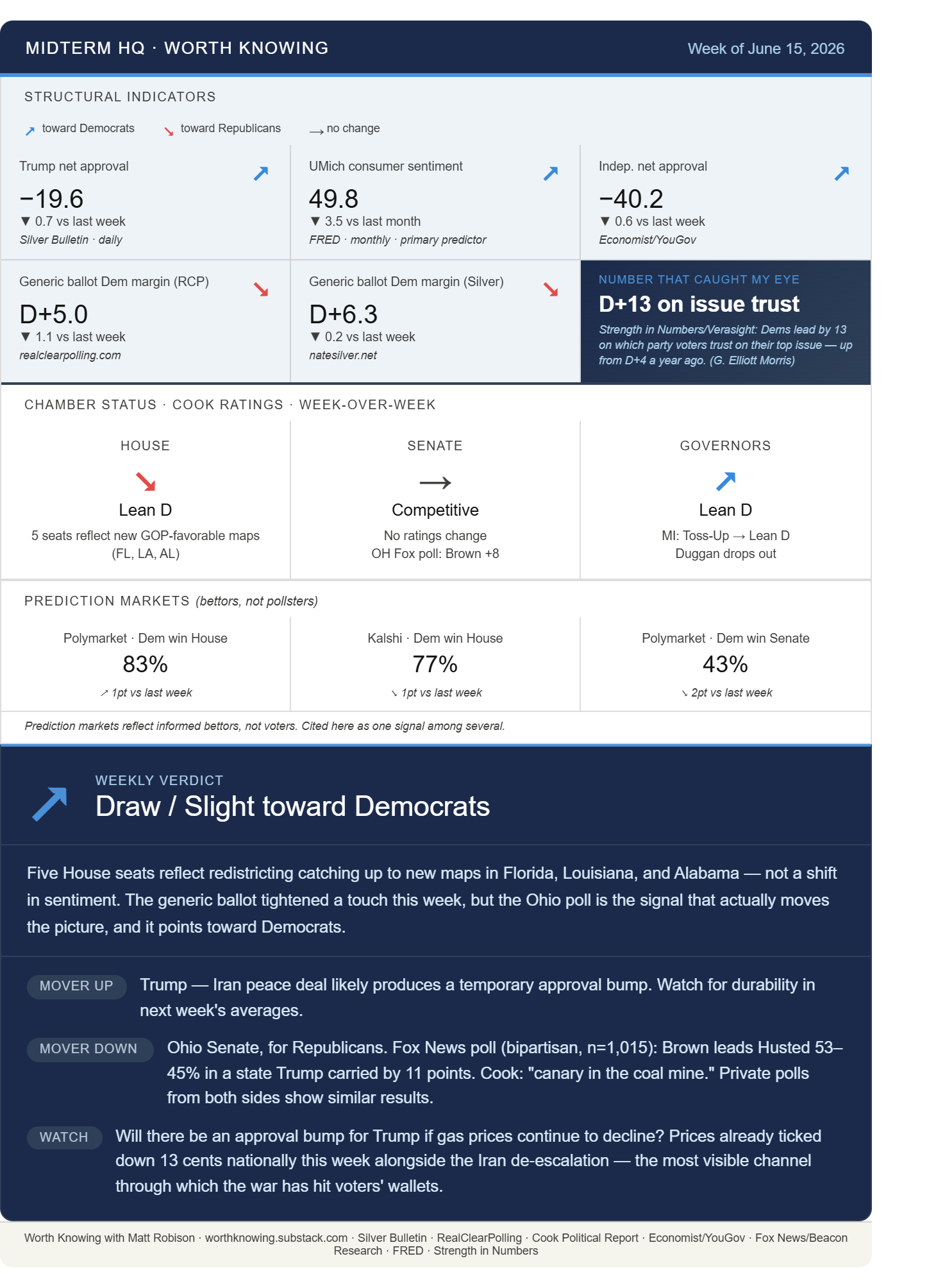
A brief note on this dashboard: I believe in AI labeling, so I use AI to generate graphics, but all writing and analysis are mine. And I believe in citing and promoting the good work of others…so if you see me citing polling averages from people like Nate Silver, analysis from people like G. Elliott Morris, or ratings from experts like Amy Walter as I do here, I encourage you to check out the source material and subscribe to them.
The structural picture
The two indicators that do the most predictive work in elections — presidential approval and economic sentiment — remain decidedly negative for Trump and the Republican Party. And by “decidedly negative” I mean “freaking awful.”
Consumer sentiment—at an all-time record low, breaking the records set in the previous two months.
Presidential approval—also down this week both among all voters and independents (which are a proxy for swing voters, though not a very good one).
The third indicator that is especially important in midterm elections is the generic ballot. The dip for Dems in the Real Clear Politics generic ballot cuts the wrong way and is worth watching, but it could be noise.1 Let’s keep an eye on this.
Overall, these numbers paint a continuing picture of a midterm that, if it were held today, would be somewhere in Democratic wave territory between “enough to boogie board but not surf” to “did you see that movie Deep Impact?”
Trump net approval (Silver Bulletin): −19.6 (↗ toward D)
UMich consumer sentiment: 49.8 (↗ toward D)
Generic ballot, Dem margin (RCP): D+5.0 (↘ toward R, down 1.1 pt this week)
Generic ballot, Dem margin (Silver Bulletin): D+6.3 (↘ toward R, down 0.2 pt)
What moved this week
House: For this first Midterm HQ I’m treating “this week” as the last several weeks, in order to reflect the new House district maps that got finalized over the course of the spring. The Charlie Cook race ratings are reflecting five seats now carrying relatively-newly-minted Republican-favorable ratings. However, it’s notable that these changes have not moved prediction markets2 appreciably. This means that the redistricting changes were already baked in to people’s expectations as they watched the Republican gerrymandering debacle, and the political environment still suggests that Democrats have more than enough momentum to flip the House.
Senate: No rating changes from Cook or Sabato. But the Fox News Ohio poll3 released one week ago, combined with Charlie Cook’s language about it (i.e., “canary in the coal mine”) was a BFD. Look, it’s only one poll, right? But Fox News polling (unlike Fox News) is legit, and Cook reports that campaign insiders from both sides have told him “yeah, this lines up with what we’re getting in our polls.”
Folks, if Ohio is leaning this far to Dems, it’s a game-changer. Suddenly, my argument that we’re looking at a likely Democratic Senate takeover starts to look…well…spot on. Worth watching whether other polls confirm this finding in the coming weeks and whether prediction markets and race ratings start to shift.
Georgia also resolved this week: Rep. Mike Collins won the Republican Senate runoff to face Jon Ossoff, but narrowly, and only after a late Trump endorsement. Will the Trump endorsement hurt in the general? That seems more likely, but worth watching.
Governors: Michigan moved from Toss-Up to Lean D after Mike Duggan dropped out on May 21. Democrats believe this may help solidify the race, and the most recent poll showing presumed nominee Jocelyn Benson with an 11 point lead in the general offers some confirmation.
One number that caught my eye
G. Elliott Morris’ Strength in Numbers Substack offered a fascinating finding this week: Democrats now lead by 13 points on which party voters trust to handle their personal top issue—up from just 4 points a year ago. He offers two explanations:
A party can make gains on the MIP-trust question for two reasons: Voters can drift toward issues where they already trust that party, or the party can gain trust to handle the issues themselves. In our data, both are happening for the Democrats today.
I would also offer a third possibility that I think is more likely: voters can also make broad judgements about how they’re feeling about the parties, and then shift their views on which party they like better on their top issue as a result. I tend to favor this mechanism because most voters are low information voters, meaning they don’t really have a lot of specifics to hang on to when it comes to individual issues, just general impressions. If they’re feeling better about Democrats—or worse about Republicans—they’ll ascribe those feelings to individual issues that concern them.
But whatever mechanism is going on, the shift Morris found is real and significant, and adds another confirming piece of evidence to the big picture.
Story you may have missed
Alaska’s election officials disqualified a second “Dan Sullivan” from the Senate ballot this week, ruling that his candidacy was filed only to confuse voters. This essentially erases a piece of mischief that could have caused a bigger headache for the incumbent Republican Senator Dan Sullivan. It’s not a huge deal, but Sullivan doesn’t need any more problems as he faces a genuine challenge this fall from former Rep. Mary Peltola, in a race that my Republican political consultant counterpart Matt Wylie says is worth watching closely.
The insider line
An anonymous, inside observation from a political professional working in campaigns right now:
Republican campaign operative “In deep red states, I’m seeing the same levels of Republican voter enthusiasm for both Trump-backed candidates and non-Trump backed candidates. But in more competitive districts it’s a different story: the Trump-backed candidates aren’t generating nearly as much Republican enthusiasm. And that’s a problem for us.”
What I’m watching next week
Two things. First, will the formal signing of the Iran “peace deal actually lead to a Trump approval bump? So far, the news coverage of the deal has leaned negative, and some leading Congressional Republicans have expressed concerns, but oil prices dropped 4% on the announcement and prices at the pump are down $0.13. Also, if there is a bump, is it durable, especially as the deal enters the detailed negotiations phase where things have a history of getting hung up?
Second, will we see more polls in Ohio that match Fox News, and new polls in Georgia now that the Senate race is set?
It is worth noting that Maryland, Utah, and New York hold primaries next Tuesday, but none of the results are expected to affect midterm swing seat prospects. In New York, the genuinely competitive seats (NY-01, NY-04, NY-17, NY-19) have incumbents who are at most lightly challenged.
The Silver Bulletin and RCP generic ballot polling averages include different polls, and RCP includes some that are more Republican-leaning. Silver Bulletin also weighs some polls more heavily than others. Which polls are in the mix and how they are weighted can move averages in ways that don’t necessarily reflect significant underlying shifts in voter sentiment.
A note about prediction markets. They are not polls, and they are subject to problems and biases like any piece of evidence. But there is research support suggesting strongly that they are an input worth weighing. I share two such studies here: https://facultyprofiles.vanderbilt.edu/esploro/outputs/preprint/Are-Betting-Markets-Better-than-Polling/991044693428503276 and https://www.sciencedirect.com/science/article/abs/pii/S0169207008000320
https://www.foxnews.com/politics/fox-news-poll-democratic-unity-republican-crossovers-shape-ohio-senate-race