
The Coming Substack Collapse
The clock is ticking to prevent an AI bleedout. There's an effective solution. Why haven't they acted yet?

Writers know how hard this can be.
I’ve re-written this sentence a dozen times (and discarded two alternate openings), as part of a personal creative process that I sorely wish I could streamline. But after writing hundreds of articles for AlterNet, Raw Story, Washington Monthly, Newsweek, and Substack over the past six years, I’ve concluded that I write the way I write: with agonizing creative destruction.
But on Substack, that’s the easy part. You’ve still got to promote your work against the thousands of other independents writing about the same topics—many with easier-to-recognize names established through years at major media outlets1—with the number of direct competitors doubling (and likely more) in the past year alone.2 It feels like you’re Luke Skywalker in the trash compactor, constantly scrambling to avoid getting crushed from all sides.
That’s not a complaint—for many of us, writing is deeply rewarding, and until recently, the challenge of getting your work seen (and compensated) has felt somewhat manageable. But a new wave AI-infused content is changing the equation. Soon, it’s going to be too much for most of us to withstand, and I’d argue that it’s likely to hollow out Substack if the platform isn’t careful.
The good news is, there’s a pretty straightforward fix for it, or at least a temporizing partial solution (if you want to see my prescription feel free to scroll down, but I think the argument that arrives there is worth it). Before I get to that, let me lay out why the AI threat is different now than it was even six months ago, and why the clock is likely ticking on the platform.
This Isn’t Last Year’s AI Anymore
The AI-on-Substack story is very different now than in 2025.
For one thing, the volume of Ai-infused writing has vastly increased, along with the overall volume of publications. Taylor Lorenz estimated that about one-third of top publications now have at least some AI-generated content,3 and Substack’s own study found that almost half of all publications were using it, with 48% of those directly using it for “writing assistance.”4
Crucially, Substack also found that over half of the people using AI started using it in the past year—which means that usage had doubled over the course of twelve months. And that study was put out in 2025: the AI uptake rate may have continued or increased since then, but it surely hasn’t diminished, meaning there’s a ton of AI-infused or straight-up AI articles flooding in. And that much additional content volume makes audience discovery that much harder for each of us needles in a metastasizing haystack.
A related emerging problem is Chimera-writing: hybrid content that mixes AI and human elements. There’s a lot more of that too: that same 2025 Substack study found that of those who use AI, 56% use it for what they label as “ideation and brainstorming,” and 65% for research.
But those are slippery categories. I once put a toe over the line on my personal no-AI-in-my-writing rule5 in drafting an article for Newsweek6 about the Trump cabinet: while using ChatGPT for research, the AI offered a single small turn of phrase that made me sit back and ponder. “Damn,” I thought, “that’s pretty clever.” So, I decided to fold in that handful of words (if you want to take a fun mini Turing Test, see if you can spot it inside the paragraph pasted into this footnote7).
The point is, even if you’re “just researching,” AI bombards us all with phrases, metaphors, and full-on sentences that are hard to un-see or keep out of your work…even for the diminishing number of us who even try to maintain an AI firewall. Which means that many of us are at the top of a slippery slope. Many more are rocketing down it or fully at the bottom. This isn’t a value judgement. It’s a reality.
The end result is that compared to a year ago, individual writers are up against at least 2x the level of competition for discovery of their work, and a significant proportion of their competitors are able to produce their output with far less effort (or practically none at all) due to AI assistance. If you’re in any business where your competition doubles and they have much lower marginal cost of production than you do, you’re going to go out of business.
And I’d argue that Substack is particularly susceptible to this kind of bleedout because of the economics of the platform.
The Vulnerable Economics of Substack
Here is an estimate of who is earning what on Substack8—you should take the specific numbers with a big grain of salt because there is limited information publicly available, but we can have reasonable confidence that this is directionally right:
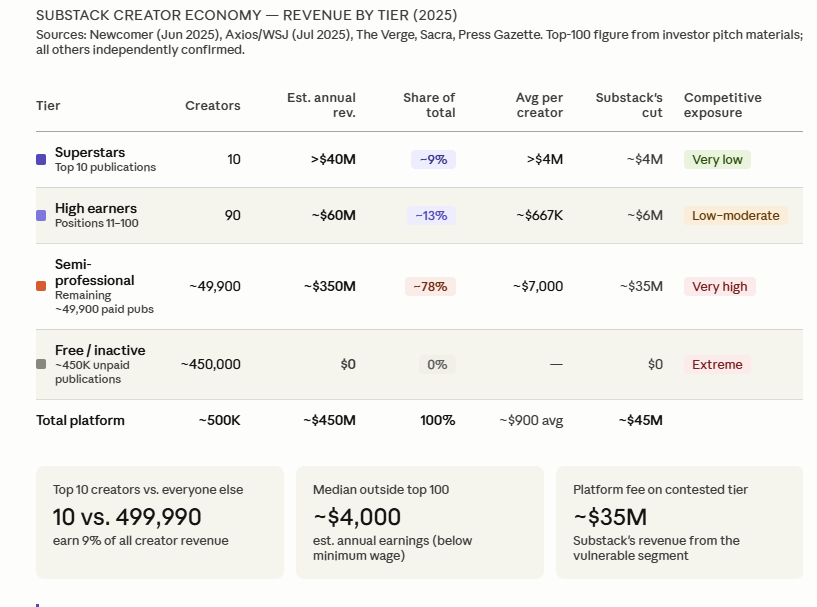
What this illustrates is the usual “superstar” structure common to many creative platforms: there’s a “long tail distribution” with a vast chasm between the very top tier of market participants and the median: on Substack it’s a 10x gap from the vast middle-class to the second tier, and then an additional 5-6x gap from the second tier to the tippy-top-ten.
A further comparison between the market structure on Substack versus on YouTube and in podcasts is illuminating: it’s something that I cover in more detail in an upcoming episode of the Washington Monthly podcast with Anne Kim, and I may write more about in coming weeks...so please subscribe!
Let me reach into my economics training (where I started my career) and give a very quick snapshot of what appears to be the market structure here, because there are three economic concepts at work that help explain why Substack is vulnerable:
Superstar economics: as explained in Sherwin Rosen's 1981 paper, "The Economics of Superstars," tech-enabled markets characterized by “joint consumption”—i.e., where creators can serve an unlimited audience at near-zero marginal cost—can spiral into a situation where a small number of top performers capture a disproportionate share of market revenue, even when the quality gap between them and second-tier performers is small.
Contestable markets: low barriers to market entry or low switching costs create vigorous competition. In the case of Substack, this may combine with relatively higher barriers to exit for the audiences to top Substackers than for the middle class audiences because of brand loyalty, network effects, inertia, and other factors.
Zero-sum attention markets: there are a bunch of closely related economic ideas here amounting to one bottom line—our attention is a zero-sum game. Audiences across most media have a consumption diet of roughly fixed size, because we all have only so much time and attention. For example, if you start listening to a new podcast an hour a week, you don’t suddenly have 169 hours available in a week. So you substitute by decreasing consumption of something else. You could sleep less. You could read less. Or you could listen to a competing podcast less. But something’s gotta give.
You can probably see already how these ideas combine to shape the situation on Substack, and why the platform has a problem. There’s a superstar structure, a contestable market, and a zero-sum attention game. The top tier of “creators” is relatively insulated while the vast middle class is in the trash compactor, vying against the current (and growing number of) monetized publications, the current (and growing number of) free or semi-active publications, and the zillions of other online media options out there (including just asking Gemini or some other free AI to generate answers or ideas for you).
So why is the whole platform particularly vulnerable to bleeding out? Because most of Substack’s revenue comes from the middle class.
Substack relies on the hundreds of thousands of writers who are getting squeezed: it appears based on the information available that something on the order of 75%-80% of their revenue comes from that tier. And those are the writers who are most likely to exit or get replaced by AI.
In years past, a writer could use a monetized Substack as one piece in a portfolio of other creative income, and also have a clear incentive to keep investing time and effort because there was a reasonable pathway to growth to the point where Substack could be a sole source of income. That’s becoming less possible and less realistic respectively. And as it does, the incentive to keep putting time in here will diminish.9
Yes, a lot of that is from other humans joining the platform, but AI-generated content is lighter fluid splashed over the fire. Not just because it supersizes the amount of competition, but also because the economic logic for writers outside the top tier will inexorably become that they have to use AI to make the return on time spent more rational (who wants to spend the kind of time I took on this piece if the ROI is so low?) or so they can get the writing done quickly to spend time on Substack Notes (which the platform is desperate for people to do)…or do more video (which Substack also apparently wants).
It’s a vicious cycle that will start to kill the strong writing at the heart of Substack’s core business model. If nothing changes, the end point is a relatively small number of economically viable Substacks floating atop a sea of enthusiastic hobbyists and highly AI-infused Chimeras and outright AI content…and an audience that only wants to pay for the top, not the slop.
The Easiest, And Best, Temporary Solution: Just Label It.
YouTube requires a label on AI-generated content. So does Facebook. Actually, so does the entire European Union: even if you put your AI-generated image in an ad on a billboard, you have to clearly say so.10 Ditto for The Atlantic and most major media outlets. Even pornography sites are contending with—and pushing labeling on—their flood of AI-content.11
Labeling isn’t a panacea, but there’s good evidence that it throws a lot of sand in the gears of AI slop.12 And there’s reason to believe that it would erect an effective sandbag barrier on Substack in particular. Substack’s major selling point is that this is where you go for authentic, distinctive, independent voices. This is an audience trained to expect human authenticity and direct connection. Receiving an email from someone is still a human act, and something we enjoy if the sender is someone we want to hear from, like Heather Cox Richardson, or Cliff Schecter, or, uh, Worth Knowing with Matt Robison. We have a word for emails that come from robots: spam. Who wants that?
Yes, this is a temporizing move. But it at least makes the Substack playing field a more even one, since we’ll all still be in a friendly competition for attention where we can use our own ideas and idiosyncrasies to our advantage and not have to shout above the artificial din. Top publications that are already well-insulated from major competition and that have started to integrate AI will no longer feel the pressure to do so—it’s like doping in sports, rational for the top performers if everyone else is doing it, unnecessary once the sport is cleaned up.
And the best part is, it’s easy, and it’s in Substack’s best long-term interests.
This is also not intended as a whiny complaint, just a description reality. People who built loyal audiences that they bring here deserve the fruits of their labor.
In May 2025, there were 50,000 monetized publications on Substack. By April 2026, there were 100,000, according to multiple sources, including the Axios Series C announcement. This is a conservative proxy for the amount of total competition, because it doesn’t count non-monetized publications.


Full disclosure: I happily use AI for image generation on Substack. I went to summer school for art in high school…no one wants to see my visual artistic sensibilities. I also use AI for copy-editing, but often I ignore its grammar suggestions because I find that its strict adherence to Strunk & White doesn’t match my writing voice.
I think this one stands up pretty well, nine months later https://www.newsweek.com/all-the-presidents-radical-men-opinion-10984788
The Trump presidency has become a platform: a plug-and-play for a motley assortment of militants with bizarre individual axes to grind who would never sniff this amount of power in any other government. Trump doesn’t run an administration so much as he hosts one: he has no durable policy objectives or vision, so as long as users pay the entry fee—in the form of furthering the flattery, money and vengeance for which he endlessly lusts—they can do what they want.
The correct answer is “Trump doesn’t run an administration so much as he hosts one.” The idea that I was suggesting in the article was that Trump was acting like a scuzzy emcee in his presidency, in the same way that his core pre-presidency business became licensing his name for other people’s products. The suggestion that he was “hosting” his administration seemed right on point, so I kept it.
Yes, I used Claude for research and table design. I stress-tested the research results and reviewed source links, but let the AI generate the summary table.
If you’re thinking that Substack can grow the audience side, and hence the market size, to keep pace, that seems unlikely. Most people have only so much time available for reading, and only so much tolerance for emails in their inbox…i.e., only so many “slots” that they are willing to fill. The superstars and top tier are relatively insulated not just because of relatively higher barriers to exit, but also because new audience members likely disproportionately come onto the platform through a superstar as an entry point, and many of those get auto-subscribed to that superstar’s recommended Substacks. So even as the audience growth, many of the available “slots” for that audience get filled.
https://digital-strategy.ec.europa.eu/en/policies/code-practice-ai-generated-content
https://www.economist.com/international/2025/11/27/ai-is-upending-the-porn-industry
https://computing.mit.edu/wp-content/uploads/2023/11/AI-Policy_Labeling.pdf
Very good stuff about writing with AI and "unseeing" things. For my own part I've treated AI much like Wikipedia, you can get a mass amount of information fast but there is definitive ratio of having to parse back through it and making sure its my words not its and so forth that pretty quickly gets into the "not worth it" decision matrix. My own little test was feeding some older published works which it kept insisting was written by someone else, which was interesting and hilarious and illuminating. The AI apologized, I called it the motherless child of an upjump toaster, great fun was had by all. All the AI models want to please the user, and pleasing the user is death to a creative writing process. I have no doubt the editorial process will be AI intensive before too long - if it isn't already- so incumbant on the writers/creators to decided the folks and AI tools they want to work with. I, too, think there is going to be a sloshing effect as AI tries to replace everything then another sloshing as that doesn't work/pushback from it. Best we can do is just do good work and let if fall where it falls, and keep our bearing doing so.
One thing I've been noticing a lot on substack recently is the phrase "let that sink in", imported from X. Or the author uses equivalents like, "sit with that for a minute.", "please take note", "pay attention here", and so on. I wonder if this is a tell of AI use.